Paris Opera House TicketsTickets & Tours
Paris · 9th arrondissement · History & architecture

Palais Garnier History & Architecture | Paris Opera House

Discover why Charles Garnier’s 19th-century opera house became a Paris landmark. Follow its construction story, explore the Grand Staircase and Grand Foyer, understand Chagall’s ceiling, and separate the Phantom of the Opera legend from history.

ArchitectCharles Garnier
Opened5 January 1875
Architectural eraSecond Empire
Historic protectionListed since 1923
01 · The big picture

What makes Palais Garnier more than an opera theatre?

It was designed as a performance venue and an elaborate public setting where 19th-century Parisian society could meet, walk and be seen.

Building and purpose

A stage for the audience, too

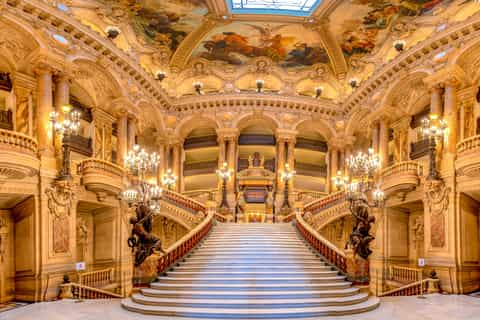
The marble Grand Staircase and richly gilded Grand Foyer are deliberately theatrical. Long before the curtain rose, visitors entered an architectural sequence designed to impress.

  • Grand entrances and circulation spaces were central to the plan.
  • Balconies provided views across the staircase and its crowds.
  • The rooms supported social life around performances.
Architecture at a glance

Second Empire grandeur

The building mixes classical forms with varied marbles, sculpture, mosaics, painting and gilding. Rather than belonging to one pure historical style, it is a celebrated example of eclectic 19th-century architecture.

  • Ornate exterior sculpture and monumental proportions.
  • Red-and-gold Italian-style auditorium.
  • Unusually lavish foyers, vestibules and staircases.
Official name

Palais Garnier

Often called Opéra Garnier or the Paris Opera House. Do not confuse it with the separate Opéra Bastille.

Performance hall

2,101 seats

The Paris Opera lists the Italian-style auditorium’s capacity as 2,101. A visit ticket is not a performance ticket.

Visitor expectation

Public rooms first

The auditorium can close for rehearsals. The staircase, foyers and galleries are the core architectural experience.

!
Palais Garnier and Opéra Bastille are different venues.

Palais Garnier is the historic building at Place de l’Opéra. Check the venue printed on any performance ticket before booking.

02 · Historical timeline

From Napoleon III’s ambition to the 1875 opening

The building’s story includes an assassination attempt, an architecture competition, war, political upheaval and a fire at the previous opera house.

  1. 1858 · A turning point: On 14 January, bombers attacked Napoleon III’s procession on its way to the former opera house on Rue Le Peletier. Security and imperial city planning helped strengthen support for a new theatre.
  2. 1860–1861 · Design competition: An international competition drew 171 proposals. The relatively young Charles Garnier, aged around 35, won the commission. The new theatre was to fit Baron Haussmann’s changing Paris.
  3. 1862 onward · Construction: Work progressed on a complex site affected by groundwater. Garnier coordinated engineering, masonry, decoration and major theatre equipment.
  4. 1867 · The exterior unveiled: The structural work was complete and the facade was revealed to the public, although the interiors and technical systems were still being developed.
  5. 1870–1871 · War and regime change: The Franco-Prussian War interrupted work. The fall of the Second Empire meant a new republican government would ultimately complete an imperial project.
  6. October 1873 · Fire at the old opera: The Salle Le Peletier was destroyed, accelerating the need to finish the new theatre.
  7. 5 January 1875 · Inauguration: Palais Garnier officially opened under the French Third Republic, although several rooms were still unfinished.
  8. 1923 · Historic monument: The building was listed for protection as a historical monument.
  9. 1964 · A new ceiling: Marc Chagall’s modern painted ceiling was inaugurated in the auditorium, placed over the original painted ceiling rather than replacing the entire architectural setting.
  10. 2025 · 150 years: Palais Garnier marked 150 years since its inauguration. It continues to serve as both a working theatre and a sightseeing landmark.
i
Why the 1875 date matters

The project began under Napoleon III, but the French Republic inaugurated it. Palais Garnier therefore embodies a major transition in French political and cultural history.

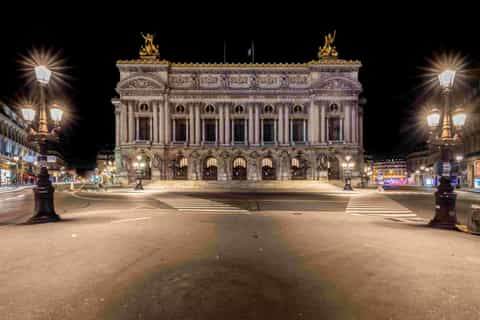
Palais Garnier exterior facade with its elaborate nineteenth-century sculptural decoration in Paris
Read the facade before enteringGarnier’s exterior announces a theatre devoted to music and dance through monumental columns, sculptural groups and decorative richness.
03 · Architectural highlights

Eight details that explain the building’s design

Look beyond the gold. Each room has a distinct role in the original theatre: arrival, socialising, spectacle or circulation.

01Signature space

Grand Staircase: a public spectacle

Broad marble flights rise through a lofty, multi-level space lined with galleries. Arriving guests could display their finery while others watched from the balconies.

What to noticeStep to an upper landing and look diagonally across the balustrades: the grand view was designed for people as much as architecture.
02Signature space

Grand Foyer: a palace-like reception hall

Gilded ornament, ceiling paintings, mirrors and chandeliers make the long foyer feel ceremonial. Audiences historically came here to meet and stroll during intervals.

What to noticeStand at either end to appreciate the long perspective, then look up at the painted programme overhead.
03Decorative detail

Avant-Foyer: mosaics and crafts

This gallery leading towards the Grand Foyer has a ceiling decorated with golden mosaics. Its sculptural details pay tribute to the craftspeople who helped create the building.

What to noticeCompare the surface textures here with the painted ceilings and mirrors of the Grand Foyer.
04Contrasting rooms

Salon du Soleil and Salon de la Lune

The Sun Lounge has a black-and-gold theme and depictions of a dragon and salamander; the Moon Lounge contrasts black and silver, with nocturnal animals such as owls and bats.

What to noticeLook up to compare how Garnier’s decorative teams turned two connected salons into contrasting worlds.
05Historic circulation

Rotonde des Abonnés

This circular area formed part of a route associated with subscribers. It helps show how the original layout separated different entrances and types of audience movement.

What to noticeThink of the building as a planned series of social journeys, not just one hall and a stage.
06Sculpture

Bassin de la Pythie

This sculptural water feature leads toward the Grand Staircase. It uses ornament to make a transition space memorable, reinforcing the building’s theatrical character.

What to noticeTake a moment at the lower level before following the movement up the stairway.
07Belle Époque detail

Salon du Glacier

Completed after the inauguration, the Glacier lounge evokes later Belle Époque decoration. It was associated with refreshments and interval social life.

What to noticeCompare its more intimate character with the grandeur of the main foyer.
08Access varies

Auditorium and Chagall ceiling

The red-velvet, Italian-style auditorium retains a historic theatrical atmosphere. Above it, Marc Chagall’s colourful 1964 painting pays tribute to celebrated composers and their works.

Access warningRehearsals frequently close the auditorium. No standard sightseeing ticket guarantees a view of the ceiling.
04 · Art meets theatre

Why Chagall’s ceiling looks so different

The auditorium captures two eras at once: Garnier’s 19th-century red-and-gold setting and Chagall’s expressive 20th-century artwork.

1964 commission

A modern layer above a historic auditorium

The French cultural authorities commissioned Marc Chagall to create a new ceiling, inaugurated on 23 September 1964. Its lively colour and musical imagery deliberately contrast with Garnier’s original interiors.

  • Chagall was asked to honour celebrated composers.
  • The new artwork was placed over the historic ceiling.
  • The central chandelier remains part of the composition.
What to look for

Music translated into colour

Rather than depicting a single scene, the ceiling uses floating figures, colour zones and references to opera and ballet. This is why it may feel surprisingly modern after the Grand Staircase.

  • Look for changing groups of colours and figures.
  • Observe the relationship with the ornate auditorium.
  • Remember that viewing it depends on auditorium access.
Architecture in three comparisons

A simple way to look more closely

01Grand Staircase

Think movement, arrival and the audience watching itself.

02Grand Foyer

Think conversation, mirrors, gilding and social display.

03Auditorium

Think live performance, red velvet and Chagall’s modern ceiling—if open.

05 · Fact versus fiction

The Phantom of the Opera: what is real?

Gaston Leroux used Palais Garnier’s dramatic setting and underground structures as inspiration, but the fictional Phantom should not be confused with historical fact.

Real building feature

There really is water beneath the opera house

Construction had to address groundwater beneath the site. The building has an underground water reservoir, which helped feed the famous story of a mysterious subterranean lake.

  • It is an engineered reservoir, not a public boating attraction.
  • Standard sightseeing tickets do not include reservoir access.
  • Do not expect to see it on a regular public tour.
Fiction and inspiration

Was there really a Phantom?

The masked character is fictional. Leroux’s novel, first published in serial form in 1909–1910, transformed the building’s theatrical atmosphere into a mystery. An 1896 chandelier-related incident also belongs to the opera house’s real history.

  • Palais Garnier is the novel’s famous architectural inspiration.
  • The Phantom is not a documented secret resident.
  • Underground-lake boat rides are not offered to ordinary visitors.
!
Don’t book expecting a “Phantom underground tour.”

Choose a themed tour only when the actual operator specifies its route. A historical storytelling experience does not automatically include restricted underground spaces.

06 · Historical facts

Palais Garnier facts worth knowing

A concise reference for the dates, names and details that help visitors understand what they are looking at.

FactVerified detailWhy it matters
ArchitectCharles GarnierSelected through a major competition in 1860–1861.
Opening5 January 1875Opened during the French Third Republic.
Original settingHaussmann-era ParisThe theatre was conceived for a transforming capital.
Architectural approachEclectic Second Empire styleCombines influences and decorative materials rather than one historic style.
Grand StaircaseMonumental marble stair and galleriesDesigned for ceremonial arrivals and social display.
AuditoriumItalian style; 2,101 seatsActive performance space, not guaranteed during visits.
Chagall ceilingInaugurated 1964Modern art layered into the 19th-century room.
Historic protectionListed since 1923Recognises the monument’s architectural significance.
Opera Library-MuseumHistorical theatre collectionsPreserves paintings, drawings, photographs and stage-design models.
Visitor addressPlace de l’Opéra, 75009 ParisSelf-guided visitor entrance is at Rue Scribe and Rue Auber.

History and room details checked against the Paris Opera’s Palais Garnier history and architecture guide and its 19th-century history overview.

07 · Plan an architecture visit

How to see the history without rushing

Allow roughly 60–90 minutes for public rooms and displays. Book the visit first, then use the architecture as a route through the building rather than a checklist of photographs.

Start with the original public route.

Notice the transitions from entrance and staircase to galleries and foyer.

Look up in the Avant-Foyer.

The ceiling mosaics and sculptures tell a different story from the gilded Grand Foyer.

Compare Sun and Moon.

The salons’ different colours and creatures show Garnier’s love of decorative contrast.

Keep auditorium plans flexible.

Rehearsals can close it without notice. Do not treat Chagall’s ceiling as guaranteed.

Check the exhibition programme.

Library-Museum displays change, and some spaces have accessibility limits.

Respect the working theatre.

Use the designated entrance, obey photography rules and leave large luggage elsewhere.

Suggested viewing sequence

Three chapters in a 90-minute architecture visit

01 · 20–25 minutesEntrance and staircase

Identify the monumental routes, sculptures and views across the stairwell.

02 · 30–35 minutesFoyers and salons

See the golden mosaics, social halls and contrast between the Sun and Moon lounges.

03 · 20–30 minutesDisplays and theatre context

Visit accessible collections and the auditorium if open; allow time to leave.

08 · History FAQs

Questions visitors ask about Palais Garnier’s past

Clear answers to common questions about its architect, architecture, artwork and famous legend.

History

Who designed Palais Garnier?

French architect Charles Garnier won the design competition as a relatively unknown young architect. The building later took his name.

Date

When did Palais Garnier open?

It was inaugurated on 5 January 1875. Construction and decoration had continued through political turmoil and war.

Architecture

What style is the Paris Opera House?

Its architecture is usually described as eclectic Second Empire design, incorporating classical forms and richly varied decorative traditions.

Art

Did Chagall paint the original ceiling?

No. Chagall’s modern ceiling was inaugurated in 1964, long after the building opened, and was installed over the earlier decoration.

Legend

Is the Phantom of the Opera a true story?

The Phantom is fictional. Palais Garnier’s history and underground water reservoir helped inspire Gaston Leroux’s story.

Tickets

Can I always see the auditorium?

No. The auditorium remains an active theatre space; access can be restricted for rehearsals or performances.

Visit the history in person

Choose a Palais Garnier ticket or architecture tour

An independent ticket suits visitors who want to study the rooms at their own pace. A guided tour adds historical explanation. These three offers are selected from the supplied booking data.

Palais Garnier historic interiors in ParisMost reviewed
★ 4.6/5 · 19,624 reviews*

Paris: Palais Garnier Self-Guided Tour

Explore the Grand Staircase, foyers and accessible public rooms at your own pace. Best for visitors who prefer time to examine architectural details.

  • Independent pace
  • Public visiting areas
From€25check live price
View details →
Dramatised guided experience inside Opera GarnierStorytelling
★ 4.6/5 · 225 reviews*

Opéra Garnier: Dramatised Guided Visit in French or English

Explore the building’s past through dramatised storytelling. Choose this format when memorable historical interpretation matters most.

  • Guided stories
  • French or English
From€40check live price
View details →
Palais Garnier Opera House tour with ManatourClassic tour
★ 4.4/5 · 170 reviews*

Paris: Palais Garnier Opera House Guided Tour by Manatour

Choose a classic guide-led introduction to Charles Garnier, the architecture and the theatre’s cultural history. Check the language before booking.

  • Guide-led
  • Architecture and history
From€25check live price
View details →

ParisOperaHouseTickets.com is an independent guide and is not affiliated with the Paris National Opera. Some links are affiliate links. *Review counts and starting prices are snapshots from supplied GetYourGuide data; confirm current totals, admission, language, cancellation terms and availability on the booking page. Auditorium access is never guaranteed.

Your next step

See the building with its history in mind

Start with Garnier’s staircase and reception rooms. Follow the 1875 construction story, compare the historic architecture with the Chagall ceiling if the auditorium is open, and choose a self-guided or guided ticket that suits your curiosity.