Paris: Palais Garnier Self-Guided Tour
A simple choice for seeing the public areas at your own pace. Auditorium access can change because of rehearsals.
Paris Opera Garnier Tickets & Tours 2026 covers self-guided entry, guided visits and performance tickets. Check ticket type, access, visit time, seating and any included extras before booking.
A simple choice for seeing the public areas at your own pace. Auditorium access can change because of rehearsals.
Paris Opera House Tickets is an independent guide, not the official website of Palais Garnier or its operator. Some links are affiliate links, and we may earn a commission at no extra cost to you. We help you compare ticket types and access.
Compare three popular ways to explore Palais Garnier, from a flexible self-guided visit to guided experiences with historical commentary. These options are ranked by traveller review count. Check the latest prices, available dates, languages and included access before booking.
1
Most reviewed
★★★★★ 4.6/5 · 19,624 reviews
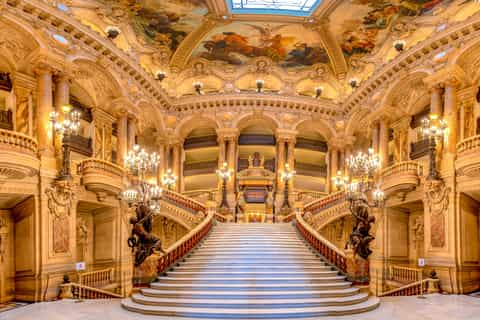
Explore the famous Paris Opera House independently and discover its magnificent 19th-century architecture. Admire the Grand Staircase, ornate Grand Foyer and richly decorated public rooms at your own pace. A good choice for visitors who prefer flexibility without a guided group. Auditorium access is not guaranteed.
2
Dramatised tour
★★★★★ 4.6/5 · 225 reviews
Discover Palais Garnier through an engaging dramatised guided experience. Hear stories about its architecture, theatrical traditions and fascinating past while exploring accessible areas of the historic opera house. Ideal for visitors who enjoy storytelling rather than sightseeing alone. Choose French or English when booking.
3
Classic guided tour
★★★★★ 4.4/5 · 170 reviews
Explore Palais Garnier with a guide who introduces its history, architecture and famous decorative features. Learn about the building’s grand interiors and its role in Parisian cultural life. A suitable option for first-time visitors who want explanations along the way. Check the selected tour language, duration and access conditions.
Not sure which Palais Garnier experience to book? Compare three popular options by price, traveller ratings, reviews and tour format. Choose a self-guided visit for flexibility, a dramatised tour for storytelling or a classic guided tour to learn about the opera house’s history and architecture.
| Option | From | Rating | Reviews | Format | Includes | Best for |
|---|---|---|---|---|---|---|
| Paris: Palais Garnier Self-Guided Tour Most reviewed option. Explore the opera house independently without following a guided group. | €25 | 4.6/5 | 19,624 | Self-guided visit | Access to designated public areas, including the Grand Staircase, Grand Foyer and historic interiors. Auditorium access is not guaranteed. | First-time visitors, independent travellers and anyone who prefers exploring at their own pace. |
| Opéra Garnier: Dramatised Guided Visit in French or English A theatrical guided experience featuring stories about the building’s history and cultural heritage. | €40 | 4.6/5 | 225 | Dramatised guided tour | Guided storytelling, historical explanations and a visit to accessible areas of Palais Garnier. French and English options are offered. | Visitors who enjoy theatrical storytelling, guided experiences and learning about the opera house’s past. |
| Paris: Palais Garnier Opera House Guided Tour by Manatour A structured guided visit focused on the opera house’s architecture, decorative interiors and history. | €25 | 4.4/5 | 170 | Classic guided tour | A guided visit with explanations of the building’s architecture, history and accessible rooms. Language and itinerary depend on the selected booking. | Architecture enthusiasts and travellers who want a guide to explain what they are seeing. |
Not sure which Palais Garnier ticket or tour to choose? Answer four quick questions about your interests, travel group, preferred experience and budget. We’ll suggest a suitable option and explain what to check before booking.
Answer the four questions above to discover a ticket or tour that matches your interests, travel plans and budget.
Recommendations consider the experience format, group preference and published starting price. Actual availability and inclusions must be checked before booking.
Tickets for the building and tickets for a performance are different products. A few practical checks can prevent a wasted journey, a refused bag or disappointment about which spaces are open on your visit date.
Standard visits need an online booking and timed entry
You cannot rely on buying a sightseeing ticket at the building. Entry is linked to your selected time slot, and arriving outside that window is not guaranteed.
Fix: Choose your date and time before travelling to Palais Garnier. Save your ticket on your phone, check the time shown on it, and allow for the security check before you reach the visitor entrance.
The main façade is not the sightseeing entrance
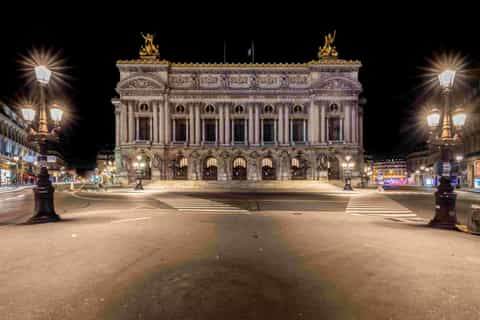
The performance address is at Place de l’Opéra, but sightseeing visitors enter at the corner of Rue Scribe and Rue Auber. Going to the front of the building can cost time.
Fix: Save the visitor entrance at Rue Scribe and Rue Auber before setting off. Follow the entrance instructions on your booking, rather than using the main façade as your meeting point.
Suitcases and travel bags cannot enter the building
Luggage and travel bags are prohibited during visits. Visitor cloakrooms are closed, so a hotel checkout day or airport transfer can leave you unable to enter with your belongings.
Fix: Arrange luggage storage before your time slot if you are carrying a suitcase or travel bag. Check the visitor rules for other restricted items, then bring only what you can keep with you.
Auditorium access is not included as a guarantee
Rehearsals and theatre activity can close the auditorium without much notice. A standard sightseeing ticket still covers the public visit route, but it does not promise access to that room.
Fix: Book the visit for its public interiors, including the staircase and foyers, rather than only for the auditorium. Check the day’s access information when booking if seeing the auditorium matters most to you.
Use this guide for visiting hours, time inside, transport, accessibility, photography, family visits and services at Palais Garnier.
Visits usually run from 10:00 to 17:00, or until 18:00 in summer, with last admission one hour before closing.
Visitor hours are listed daily from 10:00 to 17:00. During summer time, visits can run until 18:00.
Last admission is one hour before closing. Visitors are asked to head for the exit 15 minutes before the building closes.
Daytime performances and occasional closure days can change access. The auditorium and other areas may also close for artistic or technical activity.
Allow 1 to 1.5 hours for a self-guided visit; the listed visit duration is 1 hour 30 minutes.
A self-guided visit is listed at 1 hour 30 minutes. Most visitors spend between 1 hour and 1.5 hours inside.
This leaves time for the Grand Staircase, public foyers and current exhibitions where available. Access to individual rooms can change during the day.
Choose an earlier slot if you want a relaxed visit. A late slot gives less flexibility if you stop for photographs or exhibitions.
The self-guided visit covers public areas at your own pace and includes current temporary exhibitions when available.
Your visit covers the public areas of Palais Garnier. You explore them independently, rather than joining a guided group.
Current temporary exhibitions are included when they are available. Exhibition access can have separate accessibility limits for visitors with reduced mobility.
Performance tickets, the Apple Vision Pro experience and the virtual guided tour are separate products. They are not part of standard sightseeing admission.
Opéra on Metro lines 3, 7 and 8 is nearby, while Auber is served by RER A.
Use Opéra for Metro lines 3, 7 and 8. Chaussée d’Antin – La Fayette serves lines 7 and 9.
Auber on RER A is another nearby rail option. Several bus routes also serve the Opéra area, including 20, 21, 27, 29, 32, 45, 52, 66, 68, 95, N15 and N16.
If arriving by car, nearby options listed include Q-Park Edouard VII and Q-Park Meyerbeer.
All visitors pass security checks, and screening can delay entry before the visit begins.
Entry includes personal-belongings checks and secure portal screening. Leave extra time before your planned visit rather than arriving at the last minute.
Prohibited items include weapons, pocket knives, tools, aerosols, glass bottles, e-bike batteries, U-locks and large chains. Plastic bottles over 50 cl are also prohibited.
Personal mobility devices are not allowed, except those used by people with reduced mobility. Security staff can refuse items that do not meet the visitor rules.
No. Once you leave the visitor route, your exit is final and re-entry is not allowed.
Plan to see the public areas, exhibitions and bookshop before leaving. You cannot return to continue the same sightseeing visit.
This also affects meal plans. Do not expect to step outside for food and then use the same visit ticket again.
The restaurant has its own exterior entrance, so treat it as a separate stop before or after your visit.
Private photos are allowed during visits, but tripods, selfie sticks and staged photo shoots are not allowed.
You may take photographs for private use in the visitor areas. Keep clear of circulation routes and other visitors.
Tripods and selfie sticks are prohibited. You may not change clothes in visitor areas or restrooms, or use the building’s public rooms solely for a photo shoot.
Photography rules differ during performances. Do not assume that permission for a sightseeing visit applies to an opera or ballet performance.
The tour route has an accessible lift for wheelchair users, though some exhibition areas and the bookshop are not accessible.
The tour is accessible to visitors with reduced mobility, including wheelchair users. An accessible lift serves the visitor route.
Temporary exhibitions at the Opera Library-Museum are not accessible to visitors with reduced mobility. The bookshop also has accessibility limits.
French audio description is available for blind or partially sighted visitors. French Sign Language content is available on iPad mini for deaf or hard-of-hearing visitors.
Children aged 12 and under have free self-guided admission, but their free ticket still needs online booking.
Free self-guided tickets for children aged 12 and under must be booked online. They are collected from the ticket office at the time of the visit.
Pushchairs can be difficult to use around the historic tour areas. A self-guided visit lets families set their own pace.
The Revelacio children’s multimedia tour is recommended for ages 6 to 13. It lasts 1 hour and is available in French, English and Spanish.
BeauCoCo has a separate exterior entrance, while the library-bookshop is open daily from 10:30 to 18:30.
BeauCoCo is at 1 place Jacques Rouché and has a separate entrance outside the opera house. It is listed as open daily from 12:00 to 02:00.
The library-bookshop is open daily from 10:30 to 18:30, and until the end of performances. You can reach it from Rue Halévy or the theatre’s public areas.
Interval bars are for performance visitors. They are not an ordinary daytime café service for self-guided sightseeing visits.
Many visitors see Palais Garnier as a collection of lavish rooms. It makes more sense as a working theatre designed to turn arrival, waiting and performance into one public spectacle. Charles Garnier used every major space to control movement, sightlines and attention.
Palais Garnier was designed for people to watch the theatre—and each other.
Charles Garnier won the competition for the new opera house in 1861, aged 35. Construction began in 1862, and the building opened on 5 January 1875.
Its scale belongs to the rebuilding of Paris during the Second Empire. The broad Avenue de l’Opéra gives the façade a formal urban setting, while the building’s domes, sculpture and columns announce that this was meant to be a civic monument as well as a theatre.
The Grand Staircase is not simply a route upstairs. Its broad marble flights, galleries and changing viewpoints turn the crowd into part of the scene.
Look across the space rather than only upward. From the landings, visitors can see people arriving, pausing and crossing below, which reveals why Garnier made circulation feel ceremonial.
The Grand Foyer echoes the scale and rhythm of a palace gallery. Mirrors, chandeliers and ceiling painting create long perspectives that make the room feel larger and more theatrical than an ordinary interval space.
These rooms show that opera once involved social display as much as the programme. The route moves from the public city outside to increasingly elaborate interiors, preparing the audience for the auditorium.
The Italian-style auditorium holds 2,101 spectators. Its red velvet, gilded boxes and central chandelier preserve the nineteenth-century idea of a theatre arranged around both the stage and the audience.
Marc Chagall’s ceiling, painted in 1964, changes that historic setting. Its bright colour and modern language sit above the older decoration, making the room a visible conversation between different periods rather than a frozen interior.
Notice the progression from street façade to staircase, foyer and auditorium. Each space becomes more enclosed and more focused, so Palais Garnier reads as a carefully staged approach to performance, not a series of separate decorated rooms.
Yes. Online booking is required for standard sightseeing visits to Palais Garnier. Tickets are not sold at the entrance for ordinary self-guided visits.
Choose your date and entry time before arriving. Popular slots can sell out, especially during busy travel periods. Check availability before planning the rest of your day.
A standard ticket includes access to the public visiting areas, such as the Grand Staircase, Grand Foyer, decorative salons and Opera Library-Museum. Current temporary exhibitions are also included when available.
The auditorium may be closed for rehearsals or performances. Backstage areas, live performances and guided tours are not included with a regular self-guided ticket.
Sometimes. The auditorium contains the famous chandelier, red-and-gold seating and colourful ceiling painted by Marc Chagall.
However, rehearsals and performances frequently cause unexpected closures. No sightseeing ticket guarantees auditorium access, and closures do not qualify for a refund or exchange.
Official self-guided admission costs €25 for most adults from outside the European Economic Area (EEA) and €15 for eligible adults from France or the EEA.
Reduced and free admission is available for certain visitors. Prices for guided tours and third-party experiences differ, so check the final price and inclusions before booking.
Your ticket allows entry within 30 minutes of the time printed on it. Arriving after this window means your reserved admission is no longer guaranteed.
Allow extra time for security screening and use the visitor entrance at the corner of Rue Scribe and Rue Auber, behind the Charles Garnier statue.
Most visitors spend between 60 and 90 minutes exploring the accessible public rooms, staircase, foyers and exhibitions.
Allow around 90 minutes if you enjoy architecture and photography. Guided tours follow their own schedules, including shorter 45-minute flash tours.
Palais Garnier generally welcomes sightseeing visitors from 10:00 AM to 5:00 PM, with opening extended to 6:00 PM during the summer season. Last admission is one hour before closing.
Daytime performances, rehearsals and special events can change the schedule or cause closures. Always check the official calendar for your chosen date.
Yes. You can explore Palais Garnier with a self-guided admission ticket or join a guided tour without attending an opera or ballet performance.
A sightseeing ticket is separate from a performance ticket. If you want to watch a live show, check its date, venue, seating options and ticket availability before booking.
Yes. Palais Garnier welcomes families, and children aged 12 and under qualify for free standard self-guided admission.
Children still need a reserved ticket. Free tickets booked online must be collected at the designated ticket office. Guided tours have separate age-based pricing conditions.
Yes. Personal photography is allowed in accessible visitor areas, including the Grand Staircase and Grand Foyer, provided you do not disturb other visitors.
Tripods, selfie sticks and organised photo shoots are not allowed during ordinary visits. Commercial photography requires permission, and photography during performances is prohibited.
Suitcases and travel bags are prohibited. Cloakrooms are closed during sightseeing hours, so visitors cannot rely on storing luggage inside the opera house.
If you are visiting after hotel checkout or before a train journey, arrange external luggage storage first. All permitted belongings remain subject to security checks.
Palais Garnier provides an accessible entrance and a lift to reach the main visitor areas. Visitors with reduced mobility can ask staff for assistance with the accessible route.
Some historic spaces have limitations. The temporary exhibition area and gift shop are not wheelchair accessible, so check the official accessibility information before your visit.
Morning entry slots are a practical choice for visitors who want enough time to explore the interiors before lunch or afternoon sightseeing.
Weekdays outside major holiday periods may be more convenient, although quieter conditions are not guaranteed. Book an available slot that fits your itinerary and check for scheduled closures.
The nearest Metro station is Opéra, served by lines 3, 7 and 8. Auber station on RER Line A is another convenient option.
Palais Garnier is located at Place de l’Opéra, 75009 Paris. For sightseeing visits, enter at the corner of Rue Scribe and Rue Auber rather than assuming the main facade is the visitor entrance.
Official standard self-guided tickets are non-refundable and cannot normally be changed or exchanged after purchase.
Third-party tours may have different cancellation policies. Check the selected provider’s terms before paying, especially if your travel dates might change. Auditorium closures do not qualify for a refund.
Each attraction has its own visitor guide, covering opening hours, ticket options and practical route advice. This building sells two quite different visits — an hour among the staircases and foyers by day, or a seat for a performance in the evening — and the rest of the day looks different depending on which you hold. The quarter around Place de l’Opéra is also the department-store district, so much of the list below is a short walk.
Each guide is maintained by our Independent guides, with factual details checked against official sources where available. We do not sell tickets directly. Bookings are handled by third-party booking partners, and we may earn a commission at no additional cost to you.